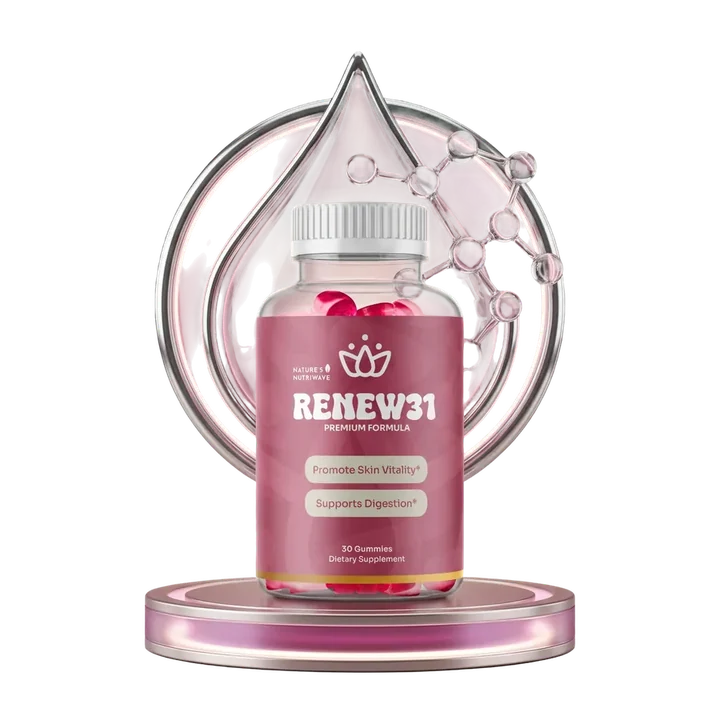
Renew31 USA retail 1 gummy a serving · 30 per bottle 60-day money-back guarantee Free US shipping on 3 or 6 bottles
Renew31Getrenew31 · authorized retailer Buy nowfrom $49 a bottle

Product information

Renew31: one gummy a day for gut and skin support

Renew31 is a chewable gummy made for everyday gut and skin support. Take 1 gummy a day with a full glass of water, about 30 minutes before a morning or afternoon meal; a bottle holds 30, so it lasts 30 days. Each gummy carries 500 million CFU of Bacillus coagulans and a 430 mg blend of 9 botanicals, among them chicory root inulin, ginger root and lion's mane.

  • 60-day money-back guarantee
  • Free US shipping on 3 and 6 bottles
  • 30 gummies a bottle, 1 gummy a day

Sources read on October 11, 2026 · who checked this page

Renew31 bottle, 30 gummies, standing beside its Supplement Facts panel
One gummy a day and 30 in a bottle, so each bottle lasts 30 days.
The Supplement Facts panel on the Renew31 bottle, transcribed line for line, with the sugar lines and the 9 blend members indented exactly as the panel indents them.
As printed on the panelAmount Per Serving% Daily Value
Calories4
Total Carbohydrate2 g1%
  Total Sugars1 g
    Includes Less Than 1g Added Sugars0%
Bacillus coagulans500 Million CFU†
Proprietary Blend430 mg†
  Chicory Root Inulin
  Babchi Powder
  Fennel Seed Powder
  Fenugreek Powder
  Ginger Root Extract
  Lemon Balm leaf Extract
  Lion's Mane Powder
  Slippery Elm Bark Powder
  Dandelion Leaf Powder

Serving Size 1 Gummy · Servings Per Container 30 · † Daily Value Not Established · Suggested use: one gummy daily with a full glass of water. The whole label is in Part A.

Guaranteed pure markVegetarian markDairy free markNaturally gluten free mark60-day money-back guarantee mark

The marks supplied with this stock: vegetarian, dairy free, naturally gluten free, guaranteed pure and a 60-day money-back guarantee.

The short answer

Renew31 is a chewable gummy made for gut and skin support. The label serving is 1 gummy a day with a full glass of water, about 30 minutes before a morning or afternoon meal, so a 30-gummy bottle lasts 30 days. Each gummy holds 500 million CFU of Bacillus coagulans and a 430 mg botanical blend. It is not a drug or an anti-ageing medicine.

Getrenew31 is a Renew31 USA retail site. We hold stock, publish what the label and the seller actually print, and take orders through the seller’s checkout. We did not formulate this product and we did not test it.

The 60-second version

Read time under a minute
  1. It is a gummy, and one a day. 30 gummies in the bottle, 1 gummy a day with a full glass of water about 30 minutes before a morning or afternoon meal, so a bottle is exactly 30 days. Because the serving is one gummy, every figure on the panel is also a per-day figure.
  2. No amount is printed inside the blend. 9 botanicals share one declared weight of 430 mg. The printed order is descending by weight, and that order is the only quantitative thing the blend carries.
  3. So every blend figure here is a maximum. Chicory root inulin, first, is capped at 430 mg, which is the whole blend. Dandelion leaf powder, last, is capped at 47.8 mg. Part B prints all 9.
  4. The sales page names 5. The label declares 10. Fennel seed powder, fenugreek powder, lemon balm leaf extract, slippery elm bark powder and dandelion leaf powder are on the bottle and in none of the sales material supplied with this stock.
  5. Two of the 5 the sales page leans on sit in the bottom half of the blend by weight. Ginger root extract and lion's mane powder are at positions 5 and 7 of 9, capped at 86 mg and 61.5 mg. That is not an opinion. It is where the label put them.
  6. “Calories 4” is not a value this panel may print. Below 50 calories the lawful values are 0, 5, 10 and so on. Part C quotes the regulation.
  7. The missing Dietary Fiber line and the 4 calories cannot both be right. Reaching 4 calories from 2 g of carbohydrate needs about a full gram of non-digestible carbohydrate, which is the line the panel does not print. Part D works every split.
  8. The probiotic is counted in CFU and in no weight at all. 21 CFR 101.36(b)(3)(ii)(A) asks for metric measures, and in 2018 FDA denied the request to let CFU stand in for weight. Part E has both sides of it.
  9. Added sugars at 0% against total sugars of 1 g. 0% of a 50 g Daily Value is under about a quarter of a gram, and the ingredient list names glucose syrup first and sucrose third.
  10. The whole blend is 14% of the lowest dose in FDA’s inulin range. FDA’s 2018 review puts inulin-type fructans at 3 to 40 g/day. The effect it recognised there is on bone mineral density and calcium absorption, not on the gut.
  11. Six of the ten are federally silent. No federal source this desk opened publishes a dose, a finding or a safety statement for them. That silence is published as a finding rather than filled in.
  12. There is no rating on this site and none in its code. 10 named reviews and a score of 4.5 on a 5-point scale were supplied with this stock. The supplied distribution produces 4.30, and one entry buys two bottles, keeps three, and reaches day 61 of a 60-day supply.
  13. Two bottles is 60 days against a 60-day refund window, so the supply and the window end on the same day and 0 bottles are left sealed to send back. Three leaves 1. Six leaves 4.

Part A

What the label prints, line for line

Not the advert and not the product page. The Supplement Facts panel is the one document in this pack that is legally required to be accurate, so everything in this part is transcribed from it rather than paraphrased from anything else. The transcription is at the top of this page, across the full width of the hero, because on this label the panel is the argument.

The Renew31 panel as supplied. Everything this site says is on the panel is on this picture, and where JavaScript runs it opens full screen and can be enlarged far enough to read the blend list.

Read it from the top. The serving is 1 Gummy and the container holds 30, which is the one division that makes every other figure on this site quotable in days rather than in servings. Then the nutrition lines. Then a line reading Bacillus coagulans 500 Million CFU with a dagger against it, and a line reading Proprietary Blend 430 mg with a dagger against that, with 9 names indented beneath it and an amount against none of them. The footnotes, as printed: **Percent Daily Values (DV) are based on a 2,000 calorie diet. Your daily value may be higher or lower depending on your caloric needs. and † Daily Value Not Established

Several things on this panel are done properly and this page says so before it says anything else. The blend is declared in descending order of predominance by weight, which is what 21 CFR 101.36(c)(2) requires and what makes any of the arithmetic below possible: “shall be declared in descending order of predominance by weight, in a column or linear fashion” 21 CFR 101.36 The dagger convention is used correctly against both lines that have no established Daily Value. And the allergen line is volunteered rather than required. What the panel does not do is reconcile with itself, and the next four parts are each one instance of that.

The Renew31 label unwrapped, showing the front panel, the Supplement Facts panel and the Other Ingredients and allergen lines

Select a number on the label, or use the arrow keys.

The blend total

One weight, 430 mg, for 9 botanicals. 21 CFR 101.36(c)(3) is explicit about what that number is: “shall be the total weight of all other dietary ingredients contained in the proprietary blend” 21 CFR 101.36

The nine names, in weight order

The order is the information. Heaviest first, as a matter of regulation rather than house style, which is the whole reason a maximum can be put on each one.

The CFU line

500 Million CFU of Bacillus coagulans, quantified in colony-forming units and in no weight at all. Part E works through it.

The Other Ingredients line

10 more substances, none of them in the blend and none of them with a weight. The first and third are the reason the sugar lines read as they do.

The Other Ingredients line reads: Glucose Syrup, Water, Sucrose, Natural Flavors, Apple Pectin, Critic Acid, Trisodium Citrate, Black Carrot Extract (Color), Vegetable oil, Carnauba Wax. One of those is a misprint, reproduced here exactly as it is printed on the bottle: Critic Acid is citric acid. A transcription that tidies the label is no longer a transcription, so the panel is quoted as printed and the correction is made here, beside it, rather than in silence. The same applies inside the blend, where the panel writes Lemon Balm leaf Extract with a lower-case leaf. Then the line No Allergens, which is the manufacturer’s own affirmative statement rather than a declaration format FDA prescribes.

Printed directions

1 gummy daily with a full glass of water, about 30 minutes before a morning or afternoon meal, or as a clinician directs.

That is the whole instruction, and it comes from the seller's FAQ rather than from the panel. One amount, one frequency, one window before a meal, a glass of water, and a clause pointing at a clinician. There is no second serving size, no loading phase and no missed-dose instruction. Where the label is silent this site is silent: how to take it says so at greater length rather than filling the gap, and the label page prints the panel again with every line annotated.

Before the arithmetic

A ceiling is not an amount, and this page never treats one as one

Three sentences that govern every blend figure on the rest of this page.

What a ceiling is

The most an ingredient could possibly weigh, given the 430 mg total and the order the law requires. It is exact as a bound and silent as a measurement.

What a ceiling is not

An estimate, a likely figure or a midpoint. The real amount sits somewhere between zero and the ceiling, and nothing published narrows it further.

Why it is worth having anyway

Because a ceiling can still settle a question. When the whole blend is 430 mg and the lowest dose in the range FDA reviewed for inulin-type fructans is 3 grams, the gap is the finding, whatever the real figure turns out to be.

The nine ceilings on this page cannot be added together. Each one assumes every ingredient above it is as light as the ordering rule allows, so they are individually true and jointly impossible. They are bounds, not a breakdown.

Part B

Five on the sales page, ten on the label

This is the thing a reader notices first, and it needs no regulation to see. The label declares 10 things: 9 botanicals inside the blend and one organism counted in CFU. The sales material supplied with this stock names 5 of them. The label wins. All ten are published here, and the 5 the sales page never mentions are named on every page that lists ingredients.

Supplied, not verified

The seller's own ingredient panel, as supplied

The seller's ingredient graphic, showing framed ingredient cards beside a photograph of the Renew31 bottle
Five names, no amounts. The panel declares ten names and gives an amount for one of them, in CFU.

Named here: Bacillus coagulans, chicory root inulin, babchi powder, lion's mane powder and ginger root extract. Declared on the label and absent from this graphic: fennel seed powder, fenugreek powder, lemon balm leaf extract, slippery elm bark powder and dandelion leaf powder.

Reproduced from the stock pack supplied with this product; not verified here.

A graphic has finite room and nobody puts ten cards on one image, so the count on its own is not the finding. The finding is what the ordering rule does to the 5 that are there. Because 21 CFR 101.36(c)(2) makes the blend list run heaviest first, ginger root extract and lion's mane powder sit at positions 5 and 7 of 9, in the bottom half of the blend by weight, capped at 86 mg and 61.5 mg respectively. Two of the ingredients the sales page leans on hardest are among the lightest things in the bottle, and the label is what says so.

21 CFR 101.36(c)(2) requires the ingredients in a proprietary blend to be declared in descending order of predominance by weight. That ordering rule is the only quantitative information this blend carries. Nothing inside the 430 mg carries a figure of its own, so the bound on the ingredient at position n is the blend total divided by n, and nothing published narrows it further.

21 CFR 101.36(c)(2), on how blend members must be listed

“shall be declared in descending order of predominance by weight, in a column or linear fashion” 21 CFR 101.36

The phrase that matters is descending order of predominance by weight. Heaviest first, as a matter of regulation rather than of house style. Without that one sentence nothing quantitative could be said about any of the 9 names indented under this blend.

21 CFR 101.36(c)(3), on what the blend number means

“shall be the total weight of all other dietary ingredients contained in the proprietary blend” 21 CFR 101.36

So 430 mg is all 9 together, and the label assigns none of it to any single name. A reader who takes 430 mg as the amount of chicory root inulin has read it as a dose rather than as a sum.

Why position 9 is capped at 47.8 mg

If the list runs heaviest first, the ingredient at position n cannot be heavier than the average of the n ingredients at or above it, because the n minus one above it are each at least as heavy. So its ceiling is 430 divided by n: 430 mg at position 1, 215 mg at position 2, and 47.8 mg at position 9. Those are the ordinary bounds. Nothing printed on this panel tightens them.

A single figure inside the blend

Had the manufacturer printed one individual weight inside this blend, every other bound would have moved. A printed figure caps everything below it at that figure and forces everything above it to be at least that much. No figure of any kind is printed inside the 430 mg, so the bounds in the table below are the only ones this label supports.

Each blend member, its position in the declared order, the most it can weigh, and whether the sales material supplied with this stock names it.
RankAs printed on the panelAt mostOn the sales page
01Chicory Root Inulin430 mgNamed
02Babchi Powder215 mgNamed
03Fennel Seed Powder143.4 mgNot named
04Fenugreek Powder107.5 mgNot named
05Ginger Root Extract86 mgNamed
06Lemon Balm leaf Extract71.7 mgNot named
07Lion's Mane Powder61.5 mgNamed
08Slippery Elm Bark Powder53.8 mgNot named
09Dandelion Leaf Powder47.8 mgNot named

Read the third column as a column of maximums and nothing else. The real amounts are not published: Nothing inside the 430 mg blend carries a figure, so the printed order is the only quantitative information there is. Read the fourth column as the gap between two documents that describe the same bottle. Every figure of that kind on this site is a ceiling. It is the most an ingredient could possibly weigh, never the amount that is in the gummy, and the real amount could be very much smaller. the ingredients page sets each of the 9 against its own source, one card at a time.

Where the pack and the label disagree, and which one this site follows

The label wins, every time. The disagreement is published rather than resolved in silence, because a reader who was shown only the winner would have no way to check the call.

The four places the material supplied with this stock and the printed label do not agree.
The disagreementWhat this site does with it
The sales page names 5 ingredients. The label declares 10.The label wins. All ten are published here, and the 5 the sales page never mentions are named on every page that lists ingredients.
The guarantee is a 60-day window, and the seller also asks for at least 30 days of use.Both are published verbatim. A 60-day window with a 30-day use expectation leaves a 30-day band in which a buyer has satisfied one condition and not the other.
Calories 4 against 2 g of total carbohydrate.At 4 calories per gram for digestible carbohydrate, 2 g is 8 calories. Reaching 4 requires about a gram of non-digestible carbohydrate - which would have required a Dietary Fiber line the panel does not print.
Total Sugars 1 g against Added Sugars at 0%.The only sugar sources in the ingredient list are glucose syrup and sucrose, and both are added sugars by definition. 0% of a 50 g Daily Value is under about a quarter of a gram.

Part C

Finding one: “Calories 4” is not a value this panel may print

Every proprietary blend hides its individual amounts, and this one is no exception. What makes this panel worth a page of its own is that it does not agree with itself. Four of its lines can be set against a quoted federal regulation and arithmetic on printed numbers, and four times the two do not meet. The first of the four needs no arithmetic at all. It is a comparison between one printed digit and one sentence of regulation.

21 CFR 101.9 governs how calories are declared, and 21 CFR 101.36(b)(2)(ii)(A) applies that rule to a Supplement Facts panel. The sentence is this: calories are “expressed to the nearest 5-calorie increment up to and including 50 calories” 21 CFR 101.9, with the further provision for the other end of the scale that declarations run in a “10-calorie increment above 50 calories, except that amounts less than 5 calories may be expressed as zero.” 21 CFR 101.9

So below 50 calories a panel has three available values and this one is not among them. Zero, if the serving holds less than 5 calories. Five. Ten. The panel prints 4.

The values 21 CFR 101.9(c)(1) makes available below 50 calories, against the value this panel prints.
CaloriesAvailable to this panel
0Available
4Not available
5Available
10Available

There are only two readings of that, and the page is going to give both rather than pick one. Either the serving genuinely holds under 5 calories, in which case the lawful declaration is 0 and the panel has printed a figure it was entitled to round away. Or the serving holds more than 5 calories, in which case the lawful declaration is 5 or 10 and the panel has printed a figure below the increment the regulation sets. Either way 4 is not on the list.

This is a labelling finding and not a safety one, and this page is not going to inflate it. Four calories a gummy is four calories a gummy, and over a 30-day bottle it is 120. Nobody is harmed by the difference between 4 and 5. What it tells a reader is something narrower and more useful: this panel was not set by someone working from 21 CFR 101.9, which is worth knowing before trusting the rest of it to be exact. And it matters a second time, because that same digit is the only thing that makes the missing fibre line a contradiction rather than an omission. the label page carries the whole panel annotated line by line.

Part D

Finding two: the missing Dietary Fiber line and the 4 calories cannot both be right

No Dietary Fiber line is printed on this panel. That absence is lawful under one condition, and the condition is contradicted by the calorie figure beside it.

The condition is in 21 CFR 101.9(c)(6)(i), which requires dietary fibre to be declared “except that if a serving contains less than 1 gram, declaration of dietary fiber is not required” 21 CFR 101.9. Under a gram, the line may come off. So the missing line is a statement in its own right: it says this serving holds less than a gram of fibre.

Now work the calories. The panel declares 2 g of total carbohydrate. 21 CFR 101.9(c)(1)(i)(C) sets the factors: digestible carbohydrate counts at 4 calories a gram, and for the non-digestible part, “A general factor of 2 calories per gram for soluble non-digestible carbohydrates shall be used.” 21 CFR 101.9 The regulation sets no express factor for the insoluble part, so this page carries it separately and treats it as zero, and says plainly that the last step is a reading of the quoted text rather than a figure the regulation states. Every split of the declared 2 g, and what each one would have forced the panel to declare:

Every way the declared 2 g of total carbohydrate can be split, the calories each split produces under 21 CFR 101.9(c)(1)(i)(C), and whether it matches the 4 calories the panel prints.
The splitDigestibleSoluble fibreInsoluble fibreCaloriesAgainst the panel
No fibre at all2 g0 g0 g8Does not match
One gram soluble fibre1 g1 g0 g6Does not match
One gram insoluble fibre1 g0 g1 g4Matches the panel
Half a gram of each1 g0.5 g0.5 g5Does not match

Only one row lands on 4, and it needs a full gram of insoluble non-digestible carbohydrate. A full gram is not less than a gram, so that row is the one row in the table that would have required the Dietary Fiber line the panel does not print. The nearest alternative, half a gram of each kind, produces 5 calories, which is a lawful value this panel does not print. With no fibre at all, 2 g of carbohydrate is 8 calories, which is double what the panel declares.

At 4 calories per gram for digestible carbohydrate, 2 g is 8 calories. Reaching 4 requires about a gram of non-digestible carbohydrate - which would have required a Dietary Fiber line the panel does not print. The two statements are each defensible on their own and they are not defensible together. This page does not resolve which one is wrong, because nothing published settles it, and guessing would be worse than leaving it open. What it does is name the fact that makes the question answerable at all: the first ingredient in the blend is chicory root inulin, which is a non-digestible carbohydrate, and the first of the Other Ingredients is glucose syrup, which is not.

What this does not mean

It does not mean the gummy contains a gram of fibre. It does not mean the gummy contains no fibre. Both of those would be inventions, and the whole point of this part is that the panel does not support either reading. A Dietary Fiber line is in the list of things this label does not publish, and that is where it stays: No Dietary Fiber is declared on this panel at all.

FDA publishes a plain-language page on which carbohydrates count as dietary fibre and how the calorie factors apply to them, and it is linked in the references at the foot of this page. the label page works the same arithmetic again with the regulation quoted in full.

Renew31, from $49 a bottle. 30 gummies at 1 gummy a day, so a bottle is 30 days.

  • 60-day money-back guarantee
  • Free US shipping on 3 and 6 bottles
  • 30 gummies a bottle, 1 gummy a day
Check price

Part E

Finding three: the probiotic is quantified in CFU and in no weight at all

The panel prints Bacillus coagulans 500 Million CFU. That is a count of living cells. It is not a weight, and the regulation that governs this line asks for a weight.

21 CFR 101.36(b)(3)(ii)(A) covers the amounts of other dietary ingredients on a Supplement Facts panel, and the sentence is short: “These amounts shall be expressed using metric measures in appropriate units.” 21 CFR 101.36 A colony-forming unit is not a metric measure of quantity in that sense. NIH ODS describes exactly what it is instead: “The number of viable cells in a probiotic supplement is indicated by the number of colony-forming units (CFU) listed on the label.” NIH ODS NIH ODS also describes the labelling position as it stands: “Current labeling regulations only require manufacturers to list the total weight of the microorganisms on probiotic products’ Supplement Facts labels” NIH ODS.

The industry asked FDA to change that. In September 2018 FDA issued draft guidance on the labelling of dietary supplements containing live microbials and denied the request to let CFU replace weight; what it offered instead was enforcement discretion for declaring CFU in addition to weight, in the case where the quantity is first listed in terms of weight. On this panel the quantity is not first listed in terms of weight. It is listed only in CFU.

Two things have to be said about that guidance and this page says both. It is draft and it is non-binding, so it is not a rule this panel has broken. And the underlying regulation it offers discretion against is binding, and that regulation asks for a metric weight that this panel does not carry. The weight of Bacillus coagulans in a Renew31 gummy is not published: The panel quantifies it in CFU and in nothing else. 21 CFR 101.36(b)(3)(ii)(A) requires other dietary ingredients to be expressed in metric measures.

The CFU figure, against the only federal description of CFU this desk could open

500 Million CFU is 500,000,000 colony-forming units, which is 5 times 10 to the power 8. NIH ODS describes what is on the market: “Many probiotic supplements contain 1 to 10 billion CFU per dose, but some products contain 50 billion CFU or more.” NIH ODS On that description 500 Million CFU sits below the lower end of the band, by a factor of about 2. And in the same fact sheet, in the sentence immediately after, NIH ODS says: “However, products with higher CFU counts are not necessarily more effective than products with a lower CFU count.” NIH ODS

Both halves of that comparison travel together on this site, always. 500 Million CFU sits below the band NIH ODS describes, and NIH ODS says in the same fact sheet that a higher count is not necessarily better. Neither sentence is a verdict on this product. A band that describes what products contain is not a threshold and it is not an effective dose. NIH ODS is explicit about why a reader cannot work backwards from a label at all: “it can be difficult to determine which products offer verifiable health benefits due to the wide variety of probiotic strains and doses found in probiotic products and inconsistent labeling practices” NIH ODS NCCIH puts the same gap more bluntly: “We also don’t know how much of the probiotic people would have to take or who would be most likely to benefit.” NCCIH

And then the fact that settles it. No federal source this desk opened publishes any dose for Bacillus coagulans. The species appears in no federal source this desk opened. NIH ODS and NCCIH name the genus Bacillus in passing lists and nothing more: no dose, no finding, no safety statement and no interaction for this organism. So there is no figure to compare 500 Million CFU against for this organism, in either direction, and no comparison on this page licenses a verdict about it.

The two probiotic safety sentences this site carries on every relevant page

“The risk of harmful effects from probiotics is greater in people with severe illnesses or compromised immune systems.” NCCIH

“Some probiotic products have been reported to contain microorganisms other than those listed on the label.” NCCIH

Neither of those is a statement about Renew31. No laboratory result for this product reached this desk in either direction, and testing and quality says so at length. They are the published cautions about the category this product is sold into, and a reader with a compromised immune system or a serious illness should have them in front of them before they order rather than after. the cautions page carries the rest.

Part F

Finding four: added sugars at 0% against total sugars of 1 g

The fourth finding is the shortest. The panel prints Includes Less Than 1g Added Sugars with 0% against it, under a total sugars line of 1 g, and the ingredient list names two added sugars.

The Daily Reference Value for added sugars is 50 g, set in 21 CFR 101.9(c)(6)(iii). A declaration of 0% therefore means the serving holds less than about 0.25 g of added sugars, because 0.25 g of a 50 g Daily Value is 0.5 per cent, which is the boundary at which the rounding to a whole per cent stops producing zero.

Now the ingredient list. The first Other Ingredient is Glucose Syrup and the third is Sucrose. Both are added sugars by definition. The total sugars line is 1 g. For the added sugars line to be right at 0%, those two ingredients together would have to account for under about a quarter of a gram of the 1 g, with the rest arriving from somewhere else. Nothing else in the ingredient list is a sugar.

The only sugar sources in the ingredient list are glucose syrup and sucrose, and both are added sugars by definition. 0% of a 50 g Daily Value is under about a quarter of a gram.

Calories

4 per gummy, with no percentage against the line. Part C is about this digit.

Total Carbohydrate

2 g at 1% of the Daily Value.

Total Sugars

1 g, with no percentage, because no Daily Value for total sugars is established.

Added Sugars

Printed as “Includes Less Than 1g Added Sugars” at 0% of a 50 g Daily Value.

Dietary Fiber

Not published. No line at all, which is lawful only under a gram. Part D is about that.

Other Ingredients

Glucose Syrup, Water, Sucrose, Natural Flavors, Apple Pectin, Critic Acid, Trisodium Citrate, Black Carrot Extract (Color), Vegetable oil, Carnauba Wax.

A gummy has to be made of something, and this page is not going to dress a gram of sugar up as a hazard. At 1 gummy a day a bottle is 30 g of total sugars across 30 days, and a reader counting sugar for any reason should have that figure rather than a percentage. What the panel does not let a reader have is the added-sugars figure itself, because the line that should carry it is declared at a percentage the ingredient list does not support.

The comparison this page will not make

A capsule version of the same blend would print no added sugar at all, and it would be easy to turn that into a sentence about which form is better. This page does not make it. No such product is in front of this desk, and a reader of this site cannot see any other product to compare this one against. What can be said is what the panel says: a chewable carries sugar where a swallowed capsule would not, and that is a trade a buyer should make knowingly.

What is not here

The list of things this label and this seller do not publish

A page that printed only what it found would be a sales page. These are the gaps, written down rather than filled in.

Everything a reader might reasonably want for this product that is not published, and why that matters.
Not publishedWhat the documents actually say
The weight of Bacillus coagulansThe panel quantifies it in CFU and in nothing else. 21 CFR 101.36(b)(3)(ii)(A) requires other dietary ingredients to be expressed in metric measures.
The individual weight of any of the 9 blend ingredientsNothing inside the 430 mg blend carries a figure, so the printed order is the only quantitative information there is.
A Dietary Fiber lineNo Dietary Fiber is declared on this panel at all.
Extract ratios and standardisationNo extract ratio, no marker compound and no standardisation percentage is printed for any of the nine botanicals.
A certificate of analysisA lot code and a certificate reference were supplied as strings. No document was.
A third-party testing markNo testing house, no certificate and no third-party seal appears in any material supplied with this stock.
A trial on the finished formulaNo published trial on Renew31 itself was supplied, and none appears in any source this desk opened.
The manufacturerNo manufacturer, facility or registration number is named in any supplied material.
Order desk opening hoursNo hours are published for the order desk.
Allergen detail behind “No Allergens”An affirmative no-allergens statement is the manufacturer’s own assertion. It is not a declaration format FDA prescribes.

the about page carries the method behind that list, the batch page explains why a lot reference and a certificate reference are not the same thing as a certificate, and testing and quality sets out what was and was not supplied with this stock. Lot R-26/GE-6641 and certificate reference R-6641-26-GE arrived as strings. No document did.

Part G

The gap that matters: 430 mg against 3 to 40 grams

Chicory root inulin is the first name in the blend, so it is the heaviest of the 9, and it is the one ingredient on this panel for which a federal source publishes a studied range. Putting the two side by side is the single most informative piece of arithmetic on this label.

FDA’s 2018 review of the scientific evidence on the physiological effects of certain non-digestible carbohydrates puts the studied intake for inulin-type fructans at “3 to 40 g/day” FDA. The entire blend on this panel weighs 430 mg, which is 0.43 g. That is 14% of the lowest dose in that range, and the lowest dose in that range is about 7 times the whole blend. Inulin alone is some part of the blend and cannot be more than all of it, so whatever the real figure is, it is smaller than 14% of 3 grams.

Read that comparison carefully. The effect FDA recognised in that review is on bone mineral density and the absorption of calcium. It is not a gut finding, and nothing on this page treats it as one. The sentence FDA actually published is this: “The strength of the evidence supports that inulin-type fructans extracted from chicory root or extracted inulin-type fructans from all sources, as well as synthetic inulin-type fructans, have a beneficial physiological effect on bone mineral density and absorption of calcium.” FDA Bone and calcium. The product is sold as gut and inner-nutrition support, and the federal finding attached to its heaviest ingredient is about neither of those things. A page that quoted the dose range without the finding beside it would have turned a bone-density review into a gut claim, and this one does not.

The whole 430 mg against 3 g

430 mg is 0.43 g. The lowest dose in the range FDA reviewed is 3 g. So the whole blend, all 9 botanicals together, is 14% of that lowest dose, and 7 whole blends would be needed to reach it. This is the generous reading: it assumes the blend is nothing but inulin.

At most 430 mg, which is the whole blend

Chicory root inulin sits at position 1 of 9, so its ceiling is the blend total itself: 430 mg. That ceiling is not an amount and the real figure is not published. The eight botanicals beneath it each weigh something, so inulin is strictly less than the whole blend, and the generous reading above is the only one the label supports.

3 to 40 g a day

“3 to 40 g/day” FDA is the studied intake in FDA's 2018 review. The top of it, 40 grams, is 93 times the whole blend. The review is linked in full in the references at the foot of this page.

Bone mineral density and calcium absorption

“The strength of the evidence supports that inulin-type fructans extracted from chicory root or extracted inulin-type fructans from all sources, as well as synthetic inulin-type fructans, have a beneficial physiological effect on bone mineral density and absorption of calcium.” FDA

That is the recognised effect in the source this page is quoting. It is not a gut endpoint, and this site never cites that review as one.

Two cautions on that arithmetic, both of which hold it down rather than up. The range is an intake studied for a particular endpoint, not a minimum anyone must reach, and falling short of it is not a finding that the product does nothing. And the blend is not pure inulin: it is 9 botanicals, of which inulin is only the heaviest. No published trial on the finished Renew31 formula was supplied with this stock and none appears in any source this desk opened. Every reference on this page describes a single named ingredient, a category of ingredients, or a labelling regulation. That is a different thing from testing this gummy. how it is said to work works through what the seller does and does not say about a mechanism, and the timeline page does the same for the question of how long anything would take.

Part H

What the federal sources say, and the six they say nothing about

Six of the ten things this label declares are addressed by no federal source this desk could open. That is not a verdict on them and it must not be read as one. It is the state of what could be read, and on this label it is the commonest fact there is.

Each of the six was actively checked against the complete NCCIH Herbs at a Glance index, the complete NIH ODS botanical list, and FDA’s Dietary Supplement Ingredient Directory, rather than searched for once and missed. Where a source carries a food-use listing but no finding, that is said as well, because a seasoning status is not a finding about a supplement. And a note on method: this site never cites PubMed or PMC as a federal finding. The National Library of Medicine runs the index; the papers in it are third-party work, and an index entry is not a federal position.

Bacillus coagulans

500 Million CFU, printed

No federal source we opened addresses it

The species appears in no federal source this desk opened. NIH ODS and NCCIH name the genus Bacillus in passing lists and nothing more: no dose, no finding, no safety statement and no interaction for this organism.

02. Babchi Powder

at most 215 mg

No federal source we opened addresses it

Absent from NCCIH, from NIH ODS and from FDA’s Dietary Supplement Ingredient Directory. No federal dose, finding or safety statement.

03. Fennel Seed Powder

at most 143.4 mg

No federal source we opened addresses it

No NCCIH page and no NIH ODS fact sheet. As with lemon balm, the only federal mention is a food-use listing at 21 CFR 182.10 and 182.20.

06. Lemon Balm leaf Extract

at most 71.7 mg

No federal source we opened addresses it

No NCCIH page and no NIH ODS fact sheet. The only federal mention is a food-use listing at 21 CFR 182.20, which is a status for a seasoning, not a finding about a supplement.

07. Lion's Mane Powder

at most 61.5 mg

No federal source we opened addresses it

Absent from NCCIH, from NIH ODS and from FDA’s ingredient directory. The only mushroom NIH ODS publishes a fact sheet for is reishi.

08. Slippery Elm Bark Powder

at most 53.8 mg

No federal source we opened addresses it

Absent from NCCIH and NIH ODS, and affirmatively not listed in 21 CFR 172.510’s table of natural flavouring substances, where the neighbouring entries are elder tree leaves, elecampane, elemi and erigeron.

Three of the nine botanicals do have a published finding, and all three are from NCCIH. Not one of the three carries a published dose, which matters more than it sounds: with no dose in the source, the ceiling this page computes cannot be compared with anything, and the comparison that made Part G possible cannot be repeated for them.

The three botanicals a federal source speaks to, the most each can weigh, what the source found, and the dose it publishes.
IngredientOn this labelWhat NCCIH publishesDose published
Fenugreek PowderPosition 4, at most 107.5 mg“There is not enough high-quality evidence to determine whether fenugreek is useful for diabetes or menstrual cramps.” NCCIH “Potential side effects of fenugreek include diarrhea, nausea, and other digestive tract symptoms.” NCCIHNot published
Ginger Root ExtractPosition 5, at most 86 mg“Research shows that ginger may be helpful for nausea and vomiting associated with pregnancy.” NCCIH “Ginger can have side effects such as abdominal discomfort, heartburn, diarrhea, and mouth and throat irritation” NCCIHNot published
Dandelion Leaf PowderPosition 9, at most 47.8 mg“There’s no compelling scientific evidence supporting the use of dandelion for any health condition.” NCCIH “We know very little about dandelion’s effect on human health.” NCCIHNot published

Fenugreek carries one more line that belongs on a page a pregnant reader might land on: “Fenugreek is not safe for use during pregnancy in amounts greater than those found in food” NCCIH. Dandelion carries a line that cuts the other way: “The use of dandelion in the amounts commonly found in food is considered likely safe.” NCCIH Both are quoted because both are published, and neither is a statement about Renew31.

  • An amount is printed, in CFU
  • Inside the blend - a maximum only
  • No federal source we opened addresses it
  • One line carries a printed amount. Bacillus coagulans, 500 Million CFU, and that amount is a count rather than a weight. Part E is about it.
  • Nine are bounded by the ordering rule and nothing else. Every botanical inside the 430 mg. The most that can be said about any one of them is a maximum.
  • Six are federally silent. No dose, no finding, no safety statement and no interaction, in any federal source this desk opened.

Those three groups are not a quality score and nothing on this site treats them as one. They overlap on purpose: Bacillus coagulans is both the one printed amount and one of the six federally silent, and five of the nine bounded botanicals are silent as well. What they record is the kind of statement the documents support, which is a different and more useful thing than a verdict. the ingredients page prints all ten as cards, the bound on the front and the source on the back.

No published trial on the finished Renew31 formula was supplied with this stock and none appears in any source this desk opened. Every reference on this page describes a single named ingredient, a category of ingredients, or a labelling regulation. That is a different thing from testing this gummy.

How to take it

One gummy a day, and everything that settles

The directions are one sentence long and they come from the seller's FAQ rather than from the panel. The arithmetic that follows from them is the reason this site can answer in days rather than in servings.

  1. One gummy, not two

    The serving is 1 gummy and the panel prints every figure per serving, so the panel’s figures are also the per-day figures: 4 calories, 2 g of carbohydrate, 500 Million CFU, and 430 mg of blend.

  2. With a full glass of water

    The directions ask for a full glass of water. It is a chewable gummy rather than a capsule, so there is nothing to swallow, and the water is part of the printed instruction rather than an inference from it.

  3. About 30 minutes before a meal

    Before a morning or afternoon meal. That is a window and a part of the day, not a clock time, and the label gives no instruction for an evening meal, so neither does this site.

  4. Count the bottle

    30 gummies at 1 gummy a day is exactly 30 days, with no rounding and no second serving size to complicate it. One gummy a day and 30 in a bottle, so a bottle is exactly 30 days. That single division is what lets every figure on this site be quoted in days rather than in servings.

  5. Or as a clinician directs

    The last clause of the printed directions, and the only place the instruction points outside itself. “The risk of harmful effects from probiotics is greater in people with severe illnesses or compromised immune systems.” NCCIH

Supplied, not verified

The seller's own how-it-works panel, as supplied

The seller's how it works panel, a numbered strip over a photograph of the Renew31 bottle
A numbered strip which between its steps is the dosing instruction, cut into pieces. No step describes a mechanism.

Reproduced from the stock pack supplied with this product; not verified here.

A panel headed with the words how it works would be expected to carry a mechanism, and this one carries the directions rebroken into steps. That is not dishonest. A supplement is not required to publish a mechanism, and inventing one would be far worse. But a reader who has read it may reasonably believe they have been told how the product works when what they have been told is when to take it. how it is said to work says the same thing at length.

Who it is for

Four questions the sources themselves raise

Nothing here is medical advice and none of it is a result this product produces. Every question comes from a sentence a federal source publishes about the category or about one of the ingredients on this label.

Four questions, from the sources rather than from the sales page

Answer them for yourself. Nothing is sent anywhere and nothing is stored.

Do you have a severe illness, or a compromised immune system?

Are you pregnant, or might you be?

Are you taking any prescription medicine?

Are you expecting a change you could see in a mirror, or on a timeline?

These statements have not been evaluated by the Food and Drug Administration. This product is not intended to diagnose, treat, cure or prevent any disease.

Part I

The reviews, and the three things in them that recompute

Ten named reviews with portraits, a score of 4.5 on a 5-point scale, a written count of 1,019 and an order figure of 2,637 were supplied to this desk as part of a stock pack. All ten are published on the reviews page, in full and labelled. None of them can be verified: no order ID, no purchase record and no contact details came with any of it. Three things in the material can be checked with arithmetic alone, and all three fail.

The distribution supplied with this stock, reproduced as the seller’s, and the mean it produces against the score published beside it.
Rating givenShare of entries
Five stars55%
Four stars28%
Three stars11%
Two stars4%
One star2%
Total100%

One. The distribution produces 4.30, not 4.5. Multiply each star value by its share, add the five products and divide by 100, and the supplied distribution averages 4.30. The figure published beside it is 4.5. The difference is 0.20, the shares add to 100 per cent so nothing is missing from the table, and no weighting is stated anywhere that would reconcile the two.

  • Two. Helen R. bought two bottles and kept three. Her card reads 2 bottles. Her text reads “Kept three bottles.” A two-bottle pack contains two bottles.
  • Three. Helen R. is on day 61 of a 60-day supply. Two bottles is 60 gummies, and the directions say one a day, so a two-bottle pack is exactly 60 days. Her card reads day 61.

Supplied, not verified

What the supplied reviews have in common

All ten supplied entries end the same way: a sentence beginning “I keep it …” and then a sentence beginning “I take it …”, or in one case a single word. The objects in those sentences are drawn from a shared pool, and four of them land in two different reviewers’ hands.

Each shared object, the entry it belongs to, and the entry it was handed to as well.
The shared objectWhose it isTheir own lineAlso handed toTheir line
The hymnalsLinda H.“I keep it by the hymnals”Walter Y.“I take it when I stack the hymnals”
The PT bandsPhyllis H.“I keep it next to the PT bands”Ethel Y.“I take it when I unroll the PT band”
The apronEthel Y.“I keep it in the shop apron”Albert V.“I take it when I hang the apron”
The keysHelen R.“I take it after I hang the keys”Albert V.“I keep it by the bus keys”

Both halves of every row are quoted from the entries as supplied, so every row can be checked against the full text on the reviews page.

Reproduced from the stock pack supplied with Renew31; not verified here.

This desk cannot prove who wrote those entries and does not claim to. What it can show is checkable, and it is the kind of thing that does not happen when ten people write about a bottle independently:

  • Two reviewers, 1,700 miles apart, both organise their day around the same stack of hymn books - one stores a bottle beside it, the other uses it as a cue.
  • The same physiotherapy bands, as a storage place for one writer and as a daily trigger for another.
  • Ethel stores the bottle in an apron; Albert hangs one. The object passes between two entries that share nothing else.
  • A set of keys is the cue in one entry and the shelf in another.

No rating, and no rating markup

This site publishes no star rating of its own and emits no rating markup, so no search engine will show stars for Renew31 on the strength of this page. The 4.5 above is the seller’s figure, reproduced as the seller’s.

Everything on this page was supplied to this desk as part of a stock pack. None of it has been verified: no order ID, no purchase record and no contact details came with any of it. It is published because refusing to show it would hide the evidence of how it was made.

The second half of that matters as much as the first. A score can be placed in a page’s code and shown nowhere on screen, and a search engine will print stars from it anyway. The code of this page carries no score, no scale, no count and no review object of any kind. the reviews page publishes the supplied material in full, labelled, beside the evidence of assembly, and emits nothing either.

The same rule governs the byline at the top of this page. A real, living, named physician was supplied with this stock as having reviewed every page, every post, the bottle and the ingredients. A physician’s name was supplied with this stock. Nothing else was - no sign-off, no date, no correspondence - so this site publishes an empty slot instead of a borrowed name. An empty slot is checkable. A name without a review is not. Her name appears nowhere on this site and in no structured data. the about page sets out the whole method.

What else was supplied with this stock and is not used as evidence anywhere on this site.
SuppliedWhy it is not used
The rating markupA score of 4.5 on a 5-point scale and a distribution were supplied. They are reproduced on the reviews page as the seller’s figures and are emitted in no structured data anywhere on this site.
The order countThe figure supplied beside the word orders is reproduced on the reviews page as the seller’s and is used nowhere else, because a count nobody can audit is not evidence of anything.
The physician’s nameSupplied with a designation and nothing else. It appears on no page of this site and in no structured data. The byline slot is published empty instead.
The recommendation figure85% was supplied with no question attached, so what was recommended, to whom, and against what alternative are all not published. It is reproduced once, as the seller’s, and never used as evidence.

Part J

Buying it, and the one division that should decide the pack

Three packs, one guarantee window, and a division that nobody puts on a sales page. 1 gummy a day and 30 gummies in a bottle means a bottle is exactly 30 days, so the supply and the 60-day refund window can be compared directly rather than guessed at.

Renew31 pack prices


2 Bottles

60 days · 2 x 30 gummies

$79 / bottle

$158 total$358

  • 2 bottles · 60 gummies
  • 60 days at one a day
  • $9.99 US shipping
  • 60-day money-back window
  • Ends the day the window does

Most popular

3 Bottles

90 days · 3 x 30 gummies

$69 / bottle

$207 total$537

  • 3 bottles · 90 gummies
  • 90 days at one a day
  • Free US shipping
  • 60-day money-back window
  • 1 bottle still sealed at day 60

Best value

6 Bottles

180 days · 6 x 30 gummies

$49 / bottle

$294 total$1,074

  • 6 bottles · 180 gummies
  • 180 days at one a day
  • Free US shipping
  • 60-day money-back window
  • 4 bottles still sealed at day 60

Orders ship from the United States unless the sales page says otherwise. Tracking arrives in the order email.

Every pack, what it costs, how long it lasts at the printed serving, how much of that falls inside the refund window, and how many bottles are still sealed on the day the window shuts.
PackTotalGummiesDays at one a dayDays inside the windowBottles still sealed at day 60
2 Bottles$15860 gummies60 days60 of 600
3 Bottles$20790 gummies90 days60 of 901
6 Bottles$294180 gummies180 days60 of 1804

The last column is the finding. On the two-bottle pack it is 0. Two bottles is 60 days of product, the window is 60 days, and the two end on the same day, so a buyer who reaches the end of the supply and wants a refund has nothing sealed left to send back. Three bottles leaves 1 bottle sealed at day 60 and 30 days of product outside the window. Six leaves 4 sealed and 120 days outside.

That is not an argument against the larger packs, which are plainly cheaper per day: with shipping the two-bottle pack works out at $2.80 a day, three bottles at $2.30 and six at $1.63. It is an argument for knowing which of the two things you are buying, the lower daily cost or the clean refund, before you choose rather than after. the pricing page works every figure through and the guarantee page does the same for the window.

The guarantee, as supplied, and the second condition inside it

60-day window from purchase. And: Sales also asks for at least 30 days of use. Confirm live checkout.

Both are published verbatim. A 60-day window with a 30-day use expectation leaves a 30-day band in which a buyer has satisfied one condition and not the other. Both sentences are published verbatim because the gap between them is the thing a buyer needs. A reader who tries the product for a fortnight has not met the use expectation; a reader who waits out the full 60 days on a two-bottle pack has nothing sealed left to return.

To claim it, call the order desk on +1 (302) 200-3480 with the order ID, and send full name, email address and order ID. Returns go to 40 West 57th Street, Floor 20, New York, NY 10019, USA, and the buyer pays return shipping, and should use a tracked service. Refunds take 3 to 5 business days after they credit the return, then 5 to 10 days for the card to show it. It is not a statement that the product works, and it is not reachable through the website address: [email protected] cannot see orders. the guarantee page and the refund policy carry the rest.

In one paragraph

Set against what it was obliged to publish, this label does several things properly. The blend is declared in descending order of weight, which is what makes any of the arithmetic on this page possible. The dagger convention is used correctly. The allergen line is volunteered. Against that: no individual weight is printed anywhere inside the 430 mg, so nine botanicals can only be bounded and never measured; six of the ten things declared are addressed by no federal source this desk opened; the sales material names five of the ten and puts two of those five in the bottom half of the blend by weight; and four lines on the panel do not reconcile with the regulation that governs them. If you are buying it, buy it knowing those things. And if you have a severe illness or a compromised immune system, if you are pregnant or might be, or if you take prescription medicine, read the cautions page and talk to a doctor before you order rather than after.

Check the current Renew31 price and the pack options

Prices, packs and the 60-day window are set on the seller’s own checkout. This site does not take payment and does not set the price. Two bottles is $158 plus $9.99 shipping, three is $207 and six is $294.

Check price and availability, from $49 a bottle

  • 60-day money-back guarantee
  • Free US shipping on 3 and 6 bottles
  • 30 gummies a bottle, 1 gummy a day

Questions

Renew31: the questions people actually type

12 questions
What is Renew31?
Renew31 is a chewable gummy dietary supplement sold as gut and inner-nutrition support, with 30 gummies in a bottle and a printed serving of 1 gummy, so a bottle is exactly 30 days. Its Supplement Facts panel prints 4 calories, 2 g of total carbohydrate, 1 g of total sugars, an added sugars line at 0% of the Daily Value, 500 Million CFU of Bacillus coagulans, and a proprietary blend of 430 mg holding 9 botanicals. It is not a drug, not an anti-ageing medicine and not a probiotic therapy.
What is in Renew31?
Ten things are declared on the label: 500 Million CFU of Bacillus coagulans, and 9 botanicals inside one 430 mg proprietary blend, in this printed order: Chicory Root Inulin, Babchi Powder, Fennel Seed Powder, Fenugreek Powder, Ginger Root Extract, Lemon Balm Leaf Extract, Lion's Mane Powder, Slippery Elm Bark Powder, Dandelion Leaf Powder. No individual weight is printed for any of the 9. Beyond the blend, the Other Ingredients line reads: Glucose Syrup, Water, Sucrose, Natural Flavors, Apple Pectin, Critic Acid, Trisodium Citrate, Black Carrot Extract (Color), Vegetable oil, Carnauba Wax. Then the line No Allergens.
How much chicory root inulin is in Renew31?
At most 430 mg, and the real figure is not published. Chicory root inulin is position 1 of 9 in the printed order, 21 CFR 101.36(c)(2) requires that order to be descending by weight, and no individual amount is printed inside the blend, so the only bound is the blend total itself. For scale, FDA's 2018 review puts inulin-type fructans at “3 to 40 g/day” and the whole 430 mg blend is 14% of the lowest dose in that range. The effect FDA recognised there is on bone mineral density and calcium absorption, not on the gut.
How many ingredients does Renew31 have, five or ten?
Ten. The Supplement Facts panel declares 9 botanicals indented under the 430 mg blend total plus 500 Million CFU of Bacillus coagulans. The sales material supplied with this stock names 5. The 5 it leaves out are Fennel Seed Powder, Fenugreek Powder, Lemon Balm Leaf Extract, Slippery Elm Bark Powder, Dandelion Leaf Powder. The label wins, and the disagreement is published on this page rather than resolved quietly.
Why does the Renew31 panel print 4 calories?
That is the first of four things on this panel that do not reconcile. 21 CFR 101.9(c)(1), applied to a Supplement Facts panel by 101.36(b)(2)(ii)(A), requires calories to be “expressed to the nearest 5-calorie increment up to and including 50 calories”, with amounts under 5 calories expressible as zero. Below 50 calories the available values are therefore 0, 5, 10 and so on, and 4 is not one of them. The lawful declaration is either 0 or 5. It is a labelling finding and not a safety one.
Does Renew31 contain fibre?
Not published, and the panel cannot be read either way. No Dietary Fiber line is printed at all, which 21 CFR 101.9(c)(6)(i) permits, “except that if a serving contains less than 1 gram, declaration of dietary fiber is not required”. But reaching the 4 calories the panel prints from 2 g of total carbohydrate needs about a full gram of non-digestible carbohydrate, because digestible carbohydrate counts at 4 calories a gram and only soluble non-digestible carbohydrate gets the 2 calories a gram factor. A full gram is not less than a gram, so the two statements cannot both be right.
How many CFU are in Renew31, and is that a lot?
500 Million CFU, which is 500,000,000 colony-forming units. NIH ODS describes the market as follows: “Many probiotic supplements contain 1 to 10 billion CFU per dose, but some products contain 50 billion CFU or more.” So this sits below the lower end of that band, by a factor of about 2. NIH ODS adds, in the same fact sheet: “However, products with higher CFU counts are not necessarily more effective than products with a lower CFU count.” Both halves belong together. And no federal source this desk opened publishes any dose for Bacillus coagulans, so no comparison supports a verdict either way. The panel also quantifies the organism in CFU and in no weight at all, where 21 CFR 101.36(b)(3)(ii)(A) asks for a weight: “These amounts shall be expressed using metric measures in appropriate units.”
How much sugar is in a Renew31 gummy?
The panel prints 1 g of total sugars and an added sugars line reading Includes Less Than 1g Added Sugars at 0% of the Daily Value. Added sugars at 0% of a 50 g Daily Value means under about 0.25 g, and the only sugar sources in the ingredient list are glucose syrup, listed first, and sucrose, listed third. Both are added sugars by definition. Over a bottle, 1 g a day is 30 g of total sugars across 30 days.
How do you take Renew31?
1 gummy daily with a full glass of water, about 30 minutes before a morning or afternoon meal, or as a clinician directs. That instruction comes from the seller's FAQ rather than from the panel. One gummy is chewed rather than swallowed. The label gives a window before a meal and not a clock time, says nothing about an evening meal and gives no missed-dose instruction, so neither does this site.
Does Renew31 have real reviews, and what is it rated?
This site publishes no rating of its own and emits no rating markup on any page. Ten named reviews with portraits and a score of 4.5 on a 5-point scale were supplied with this stock, and not one of them can be verified: no order ID, no purchase record and no contact details. All ten are published on the reviews page, labelled, because three things in the material recompute and all three fail. The supplied distribution averages 4.30 rather than 4.5; one entry buys a two-bottle pack and says three bottles were kept; and the same entry is dated day 61 of a 60-day supply. Four concrete objects also appear in two different reviewers' hands.
Has a doctor reviewed the Renew31 pages on this site?
No, and the byline slot is published empty to say so. A physician’s name was supplied with this stock. Nothing else was - no sign-off, no date, no correspondence - so this site publishes an empty slot instead of a borrowed name. An empty slot is checkable. A name without a review is not. The name was supplied as having reviewed every page, every post, the bottle and the ingredients. It appears nowhere on this site and in no structured data, and no page here emits a reviewer object.
How many bottles of Renew31 should I buy?
That is a question about the refund window rather than about the product. At 1 gummy a day two bottles is 60 days against a 60-day window, so the two end together and 0 bottles are left sealed to send back. Three bottles leaves 1 sealed and six leaves 4. The larger packs are cheaper per day: $2.80 with shipping, $2.30 and $1.63. The seller also asks for at least 30 days of use, which is a second condition inside the same window.

References

  1. Code of Federal Regulations, Title 21, Section 101.9. Nutrition labeling of food. https://www.govinfo.gov/content/pkg/CFR-2024-title21-vol2/xml/CFR-2024-title21-vol2-sec101-9.xml
  2. Code of Federal Regulations, Title 21, Section 101.36. Nutrition labeling of dietary supplements. https://www.govinfo.gov/content/pkg/CFR-2024-title21-vol2/xml/CFR-2024-title21-vol2-sec101-36.xml
  3. U.S. Food and Drug Administration. FDA issues draft guidance on labeling of dietary supplements containing live microbials. September 6, 2018. https://www.fda.gov/food/hfp-constituent-updates/fda-issues-draft-guidance-labeling-dietary-supplements-containing-live-microbials
  4. U.S. Food and Drug Administration. Questions and Answers on Dietary Fiber. https://www.fda.gov/food/nutrition-food-labeling-and-critical-foods/questions-and-answers-dietary-fiber
  5. U.S. Food and Drug Administration. Review of the Scientific Evidence on the Physiological Effects of Certain Non-Digestible Carbohydrates. June 2018. https://www.fda.gov/media/113659/download
  6. NIH Office of Dietary Supplements. Probiotics: Fact Sheet for Health Professionals. https://ods.od.nih.gov/factsheets/Probiotics-HealthProfessional/
  7. National Center for Complementary and Integrative Health. Probiotics: What You Need To Know. https://www.nccih.nih.gov/health/probiotics-what-you-need-to-know
  8. National Center for Complementary and Integrative Health. Fenugreek. https://www.nccih.nih.gov/health/fenugreek
  9. National Center for Complementary and Integrative Health. Ginger. https://www.nccih.nih.gov/health/ginger
  10. National Center for Complementary and Integrative Health. Dandelion. https://www.nccih.nih.gov/health/dandelion

Every source above was opened and read on October 11, 2026. None of them tested Renew31 itself. They describe single ingredients and the categories they sit in and the labelling regulations that govern this panel, which is a different thing from testing this finished formula.

Renew31, from $49 a bottle 60-day money-back guarantee · free US shipping on 3 and 6 bottles Check price